“Heil Hitler” Nazi salute and greeting requirement
The Book ThiefThe “Heil Hitler” Nazi salute and greeting requirement is not merely a phrase of courtesy but a political technology: it makes allegiance visible in the voice, the raised arm, and the smallest encounter in public life. Its repeated use shows how Nazi Germany enters bodies and routines, demanding that people perform loyalty before they can march, shop, or belong. At the same time, the requirement creates a field of tension in which compulsory gestures can conceal fear, misery, indifference, or refusal.
Definition and Institutional Use
The rule appears first as part of the political education imposed on children. When Liesel Meminger turns ten, she receives the small brown uniform associated with the Hitler Youth and is enrolled, as a girl, in the BDM, the Bund Deutscher Mädel. The organization’s first task is to ensure that the children’s “heil Hitler” is functioning properly. The greeting is therefore taught as a bodily skill before marching, bandage-rolling, sewing, hiking, and other activities. Meetings occur every Wednesday and Saturday from three to five in the afternoon, giving the formula a repeated place in the rhythm of childhood.
Hans Hubermann escorts Liesel Meminger to these meetings and collects her two hours later. Their silence on the walks is significant: the rule is present without needing explanation, carried in the hands they hold and in the social world through which they move. The greeting belongs to an organized system that trains children to reproduce the state’s gestures, but the private relationship between Hans Hubermann and Liesel Meminger gives those gestures a different emotional charge from the one intended by the institution.
Enforcement in Everyday Life
The requirement extends beyond formal organizations into commercial life. Frau Diller’s shop on Himmel Street is described as white, cold, and bloodless, an atmosphere she actively administers. Her allegiance to the Third Reich is made material through a framed photograph of the Führer, the sale of scarce goods under the counter during rationing, and donations to the Nazi Party. In her shop, the greeting becomes a condition of service: anyone who enters without saying “heil Hitler” will not be served.
Rudy Steiner warns Liesel Meminger to say “heil” when entering Frau Diller’s shop unless she wants to walk farther. The warning reveals the rule’s practical force. It is not necessary for Frau Diller to argue politics or physically threaten a customer; the possibility of being refused ordinary goods is enough to make the salute function as discipline. Her “soldierlike posture,” refrigerated manner, and glaring eyes turn the shop into a miniature checkpoint where speech proves conformity.
Public Spectacle and Collective Pressure
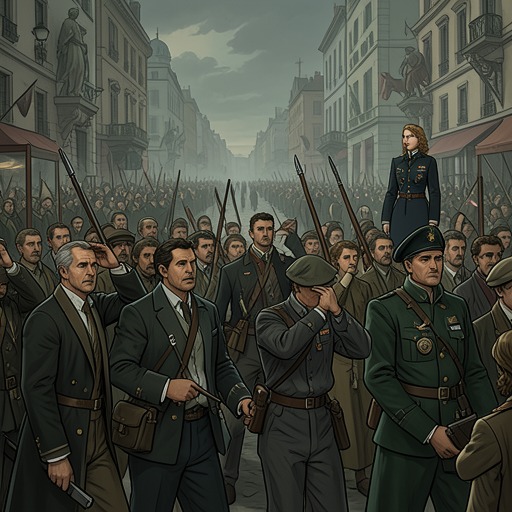
The greeting reaches its most theatrical form at a mass political gathering. Liesel Meminger sees a horizon of Nazi flags and uniforms, a crowd so unified that it seems impossible to resist, reason with, or even move through independently. The people breathe with it, sing its songs, and wait for its fire. A man in a shiny brown uniform requests silence, and his first words are “Heil Hitler!” His first action is the salute to the Führer.
The sequence binds language to movement and movement to collective identity. The phrase does not simply announce the speaker’s belief; it initiates the ceremony and directs the crowd toward a shared political script. The speaker then celebrates Adolf Hitler’s birthday and claims that the regime has again stopped its enemies from reaching into German minds. The greeting thus frames a larger promise of ideological protection: the state presents obedience as defense against contamination, while the crowd’s synchronized response makes dissent appear physically and socially impossible.
Private Rehearsal and Moral Strain
Hans Hubermann later rehearses the salute with Liesel Meminger on the church steps, presenting the exercise as preparation for a future lecture. He stands erect at the bottom of the steps, cocks his arm to forty-five degrees, and says “Heil Hitler.” Liesel Meminger raises her own arm and repeats the words with absolute misery, trying not to cry. The scene makes visible what the public ceremony suppresses: the body can perform the required action while the person inside the performance experiences pain and rejection.
Hans Hubermann’s lesson is practical rather than celebratory. He is preparing Liesel Meminger for a danger that will arrive on Himmel Street later that year, in the early hours of a November morning. The rehearsal therefore gives the greeting a double meaning. It is an imposed sign of loyalty, but it is also a protective maneuver undertaken within a threatening political order. When Liesel Meminger asks whether they are still friends, the question exposes the emotional cost of making a child enact a gesture associated with power. Hans Hubermann’s cigarette functions as a small peace offering afterward, and Liesel Meminger responds by rolling it for him without speaking.
Language, Power, and Resistance
The rule belongs to a wider struggle over words. Liesel Meminger knows only one label connected with her father: “Kommunist,” a strange word she has heard repeatedly without understanding. Later, an embedded story describes a young man who wants to rule the world and discovers the power of words after observing a mother soothe a crying child. The discovery leads him to exclaim “Words!” The juxtaposition clarifies why a greeting can carry political force: words do not remain abstract when institutions attach them to uniforms, salutes, access, and punishment.
The formula’s repetition also places it beside other forms of language in the novel. Nazi speech seeks to make minds uniform, while books and storytelling preserve experiences that ideology would erase. The public greeting claims to unify the population, yet its very compulsion reveals that unity is not spontaneous. At the edge of the narrative, the world whistles and the rain is stained as the black book disintegrates under the narrator’s travels. Against the regime’s demand that one phrase be repeated until obedience becomes automatic, the surviving act of storytelling gives words another function: remembering what political language tried to control.
Narrative Significance
As a rule, the “Heil Hitler” Nazi salute and greeting requirement marks the boundary between private feeling and public safety. Children learn it as part of institutional membership; customers use it to obtain goods; crowds enact it in ceremonies; and Liesel Meminger is coached to perform it even when the gesture makes her miserable. These contexts show a progression from training, to routine enforcement, to mass spectacle, and finally to intimate rehearsal.
Its significance lies in that range. The requirement makes Nazism ordinary by inserting it into the doorway of a shop, the schedule of youth meetings, and the posture of an eleven-year-old on church steps. Yet the same repetition allows the narrative to distinguish compliance from conviction. A raised arm may satisfy the state while failing to command the heart. The greeting’s apparent simplicity is therefore deceptive: it is a compact instrument of surveillance, belonging, and ideological theater, but it also becomes evidence of the pressure under which people attempt to remain human.